Research 03 / Storage and integration
Tanks Within the Chassis
Test question: how much usable fuel can be carried once the vessel, protection, plumbing and service envelope are counted?
Fuel mass is not system massBegin with the installed envelope.
Hydrogen carries substantial chemical energy per kilogram of fuel. Its low density means the vehicle still needs a substantial storage solution. Compressed gas uses pressure vessels; liquid hydrogen uses a cryogenic system with insulation and additional thermal-management considerations. Neither can be represented fairly by the fuel’s mass alone.
The installed envelope includes tank walls, mounts, valves, regulators, lines, sensors and protective structure. It also includes space that must remain accessible for inspection or component replacement. A clean computer model that fills every visible gap can therefore overstate what a serviceable vehicle can carry. The useful question is not simply whether a cylinder fits, but whether the complete system can operate and be maintained there.
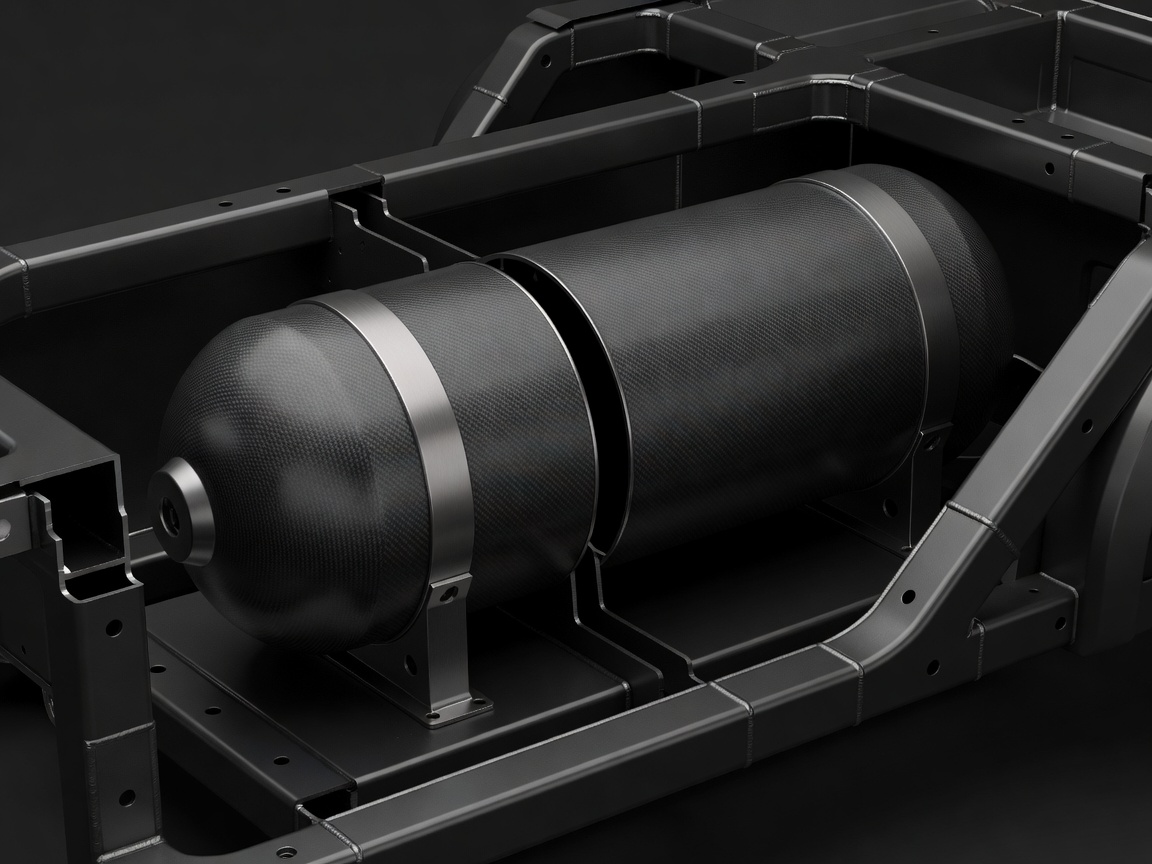
Established principle: vessel shape matters.
Pressure containment favours geometries very different from a flexible petrol tank. Cylindrical composite vessels with shaped ends can be structurally efficient, yet leave awkward unused spaces within a racing chassis. Several smaller vessels may fit a particular layout better, while adding connections, mounting interfaces and potentially more hardware mass.
The mounting strategy must consider loads without imposing damaging constraints on the vessel. Chassis deflection, impact exposure, temperature and inspection requirements are part of that problem. A vessel certificate does not certify the entire vehicle installation. Protection, attachments and routed connections need their own assessment under the applicable competition rules and engineering process.
Fuel location can also influence vehicle behaviour. The storage package occupies space that might otherwise serve aerodynamics, cooling, suspension or driver accommodation. Fuel consumption changes mass over a stint, but the vessel and its protection remain. Any handling comparison needs the complete mass distribution rather than a simple comparison of fuel weights.
Compressed gas and liquid are different systems.
For compressed storage, delivered fuel quantity depends on pressure, temperature and the permitted operating envelope. Fast filling changes gas temperature. A pressure reading on its own is not a complete measure of stored mass, and nominal capacity is not necessarily the quantity available to the propulsion system under every operating condition.
Liquid hydrogen offers a different density trade-off, but requires very low temperatures. Heat entering the storage system can cause evaporation and pressure changes. Insulation, vent management and procedures during waiting periods become important parts of the vehicle’s operating concept. A demonstration that runs immediately after preparation does not answer every question about delays or interrupted sessions.
Neither choice removes the need for carefully engineered leak detection, isolation and release management. Hydrogen can disperse quickly in some open settings and accumulate in poorly ventilated spaces. Risk depends on geometry and circumstances; describing it as automatically safe or inherently unmanageable would skip the actual analysis.

Published examples and standards have boundaries.
Toyota’s hydrogen competition development has publicly explored both compressed and liquid storage routes. MissionH24 provides another published reference for packaging hydrogen within an endurance prototype concept. These programmes make storage integration tangible, but their vehicle layouts do not establish a universal best arrangement for another class or chassis.
ISO 19881 concerns gaseous hydrogen land-vehicle fuel containers. SAE J2579 addresses hydrogen fuel-system safety in its stated vehicle context, while UN Global Technical Regulation No. 13 concerns hydrogen and fuel-cell vehicle safety. Their scope, current edition and applicability must be checked. A road-vehicle standard should not be presented as automatic permission to compete.
The FIA and individual series organisers may impose additional technical and operational requirements. Approval can involve vehicle design, fuelling equipment, personnel competence and event infrastructure. A general article cannot resolve those obligations for a particular entry, and a manufacturer’s component rating does not replace the organiser’s acceptance process.
Unresolved questions reach into the pit lane.
A useful programme measures how much fuel reaches the vehicle, how much remains usable and how consistently the process can be repeated. It also examines connector access, inspection time and the effect of thermal conditions on turnaround. A headline filling duration is incomplete if it excludes preparation, checks or recovery after an abnormal interruption.
Event logistics belong in the same discussion. Fuel delivery, conditioning, storage and personnel arrangements may determine whether a technically workable car can operate reliably through a race meeting. Those constraints vary between venues and should be documented rather than assumed away.
The bench conclusion is straightforward: storage is an active subsystem that shapes the vehicle and its operations. Judge it by usable energy, complete installed mass and volume, verified protection and a workable service concept. Fuel density alone cannot make that decision.
Source bench
- US Department of Energy: hydrogen storage — storage fundamentals and research challenges.
- ISO — current scope and edition of ISO 19881.
- SAE standards — current publication details for SAE J2579.
- UNECE vehicle regulations — UN GTR No. 13 and its regulatory context.
- FIA — applicable motorsport regulations and safety publications.